Project 1 of 10
Ascent
An adaptive, gamified learning platform — a tutor that teaches any subject at exactly the altitude you choose.
Ever sat in a class moving too fast to follow — or so slow you just checked out? What if one tutor could teach any subject at exactly your speed, and make coming back tomorrow feel worth it?
See it work
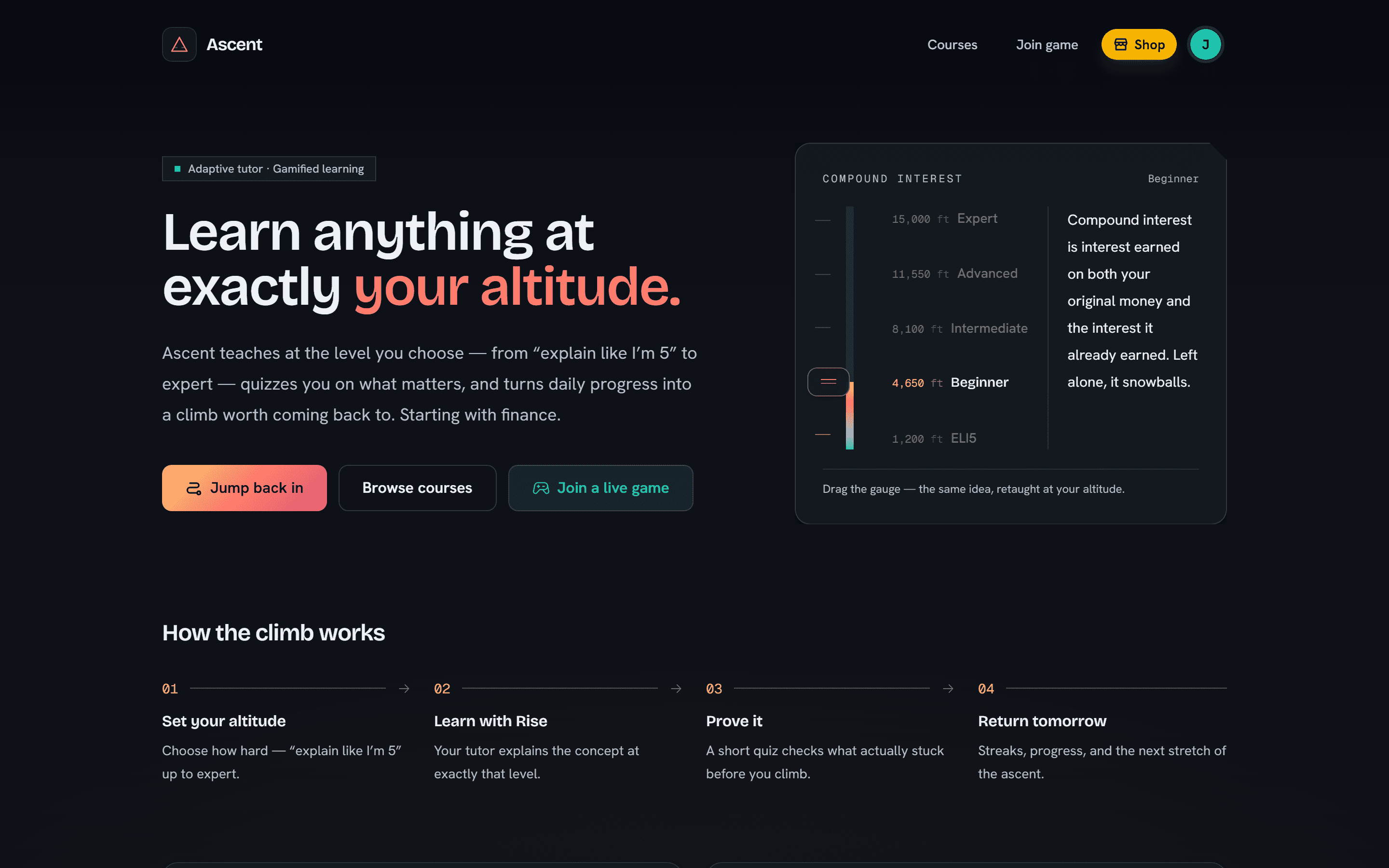
Pick how hard it is.
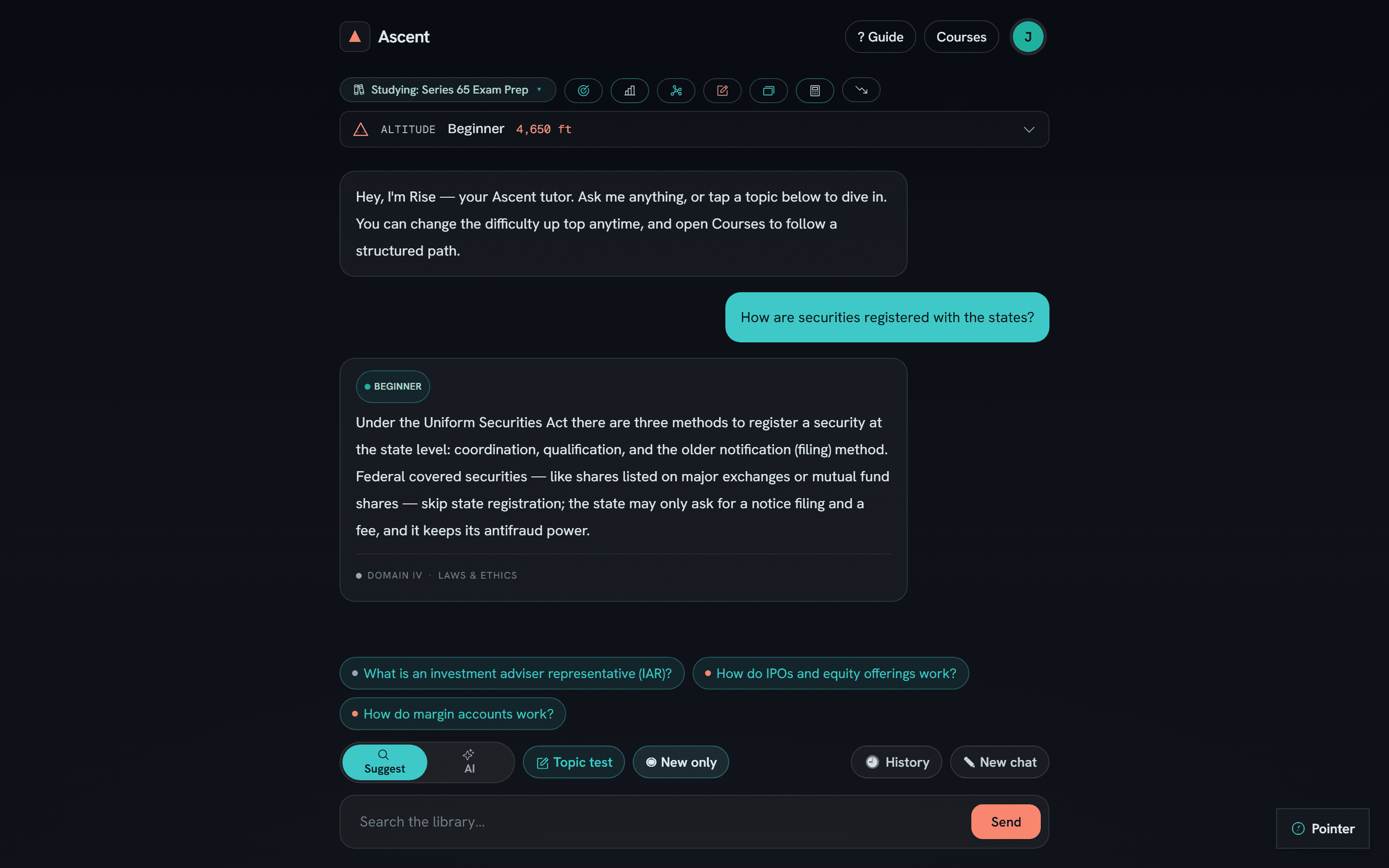
It nudges you on what to ask next.
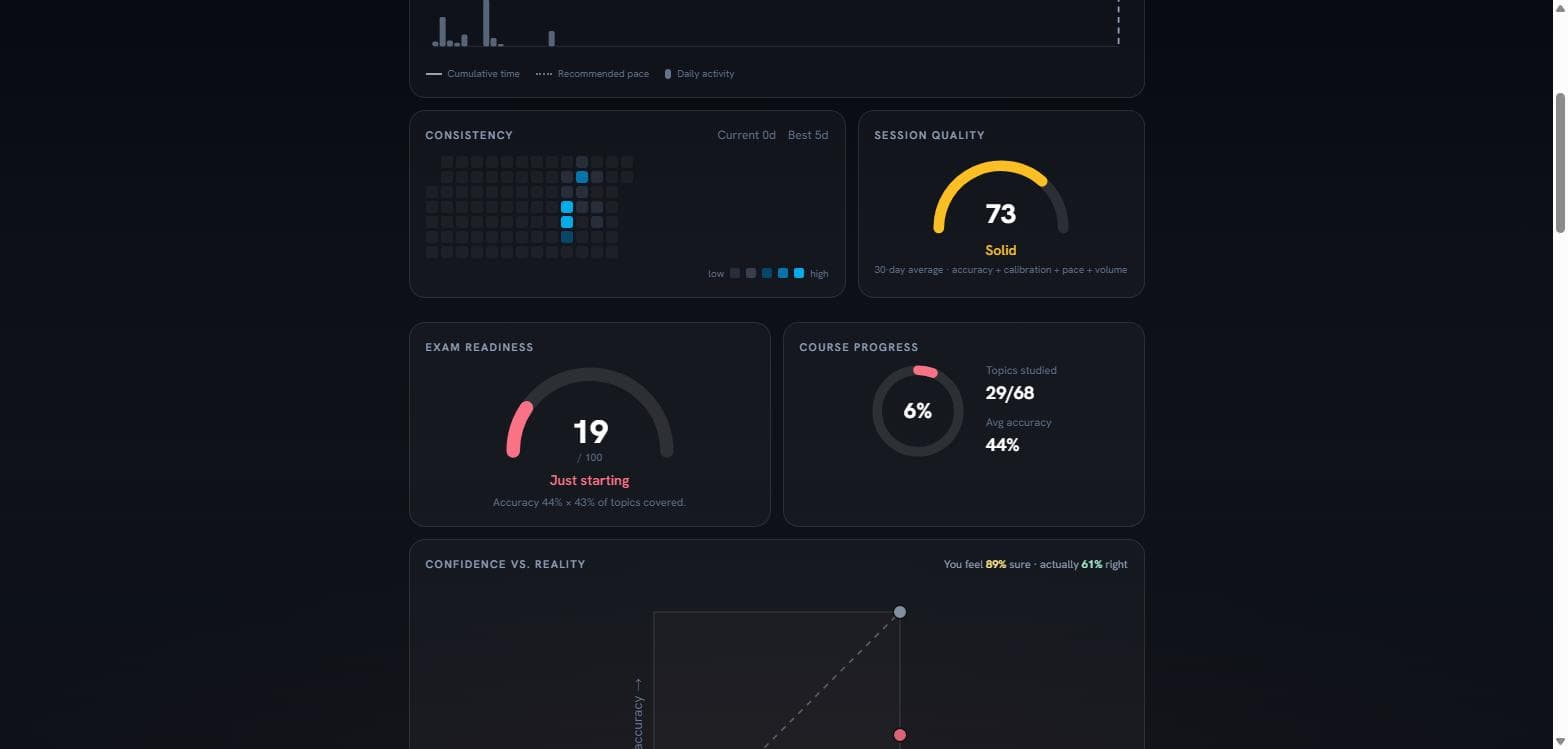
It measures what you actually know.
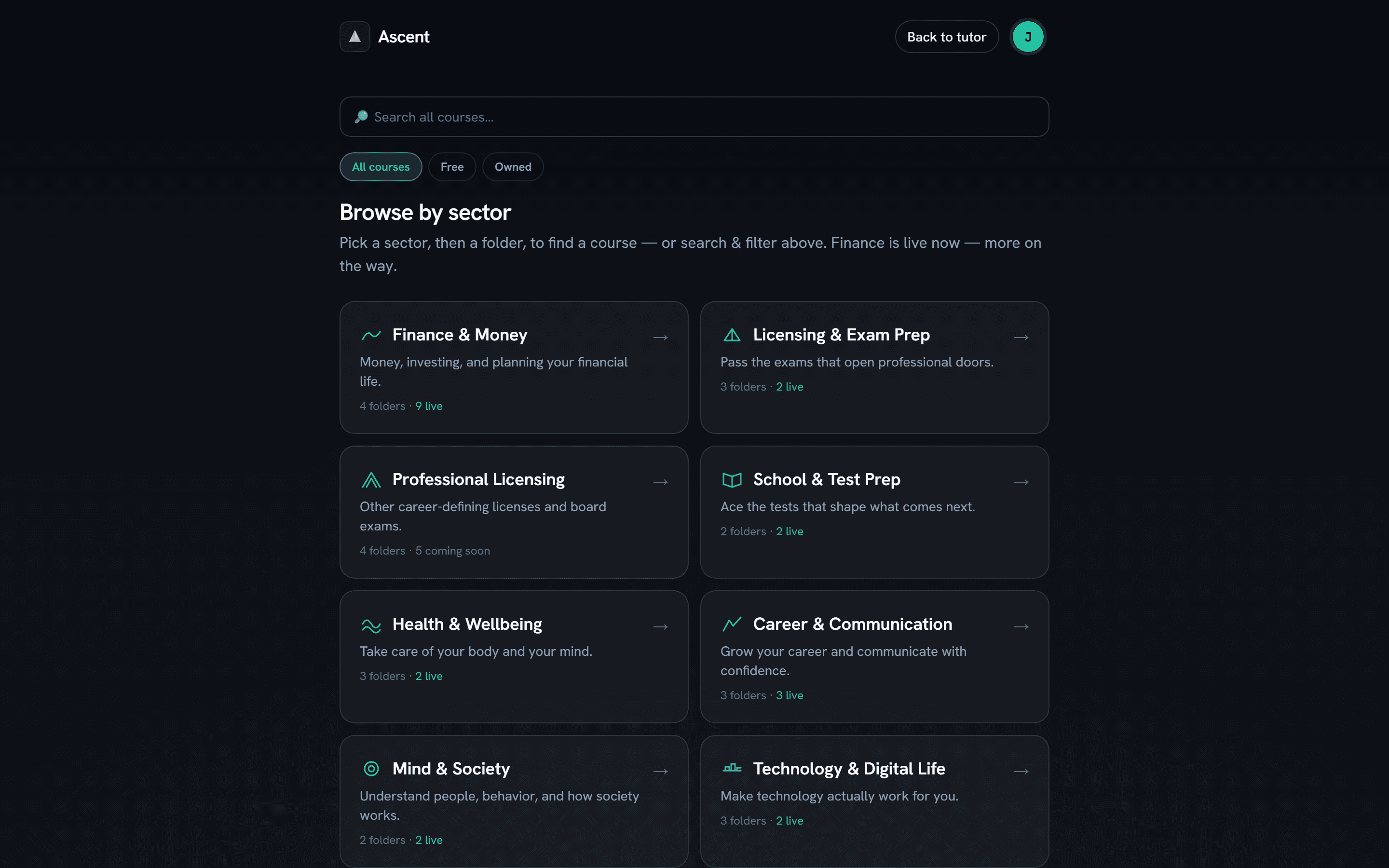
Learn almost anything.
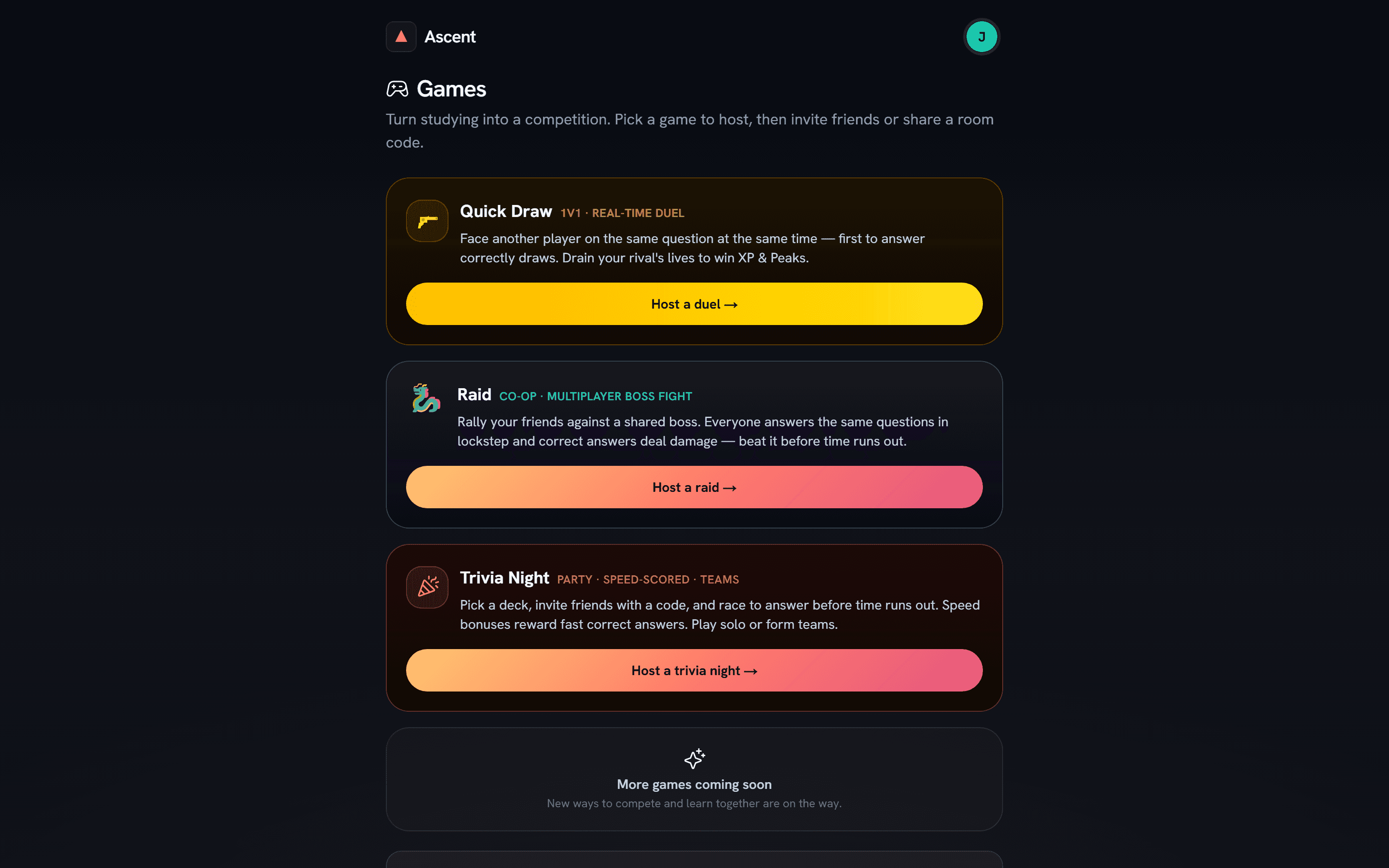
Turn studying into a game with friends.
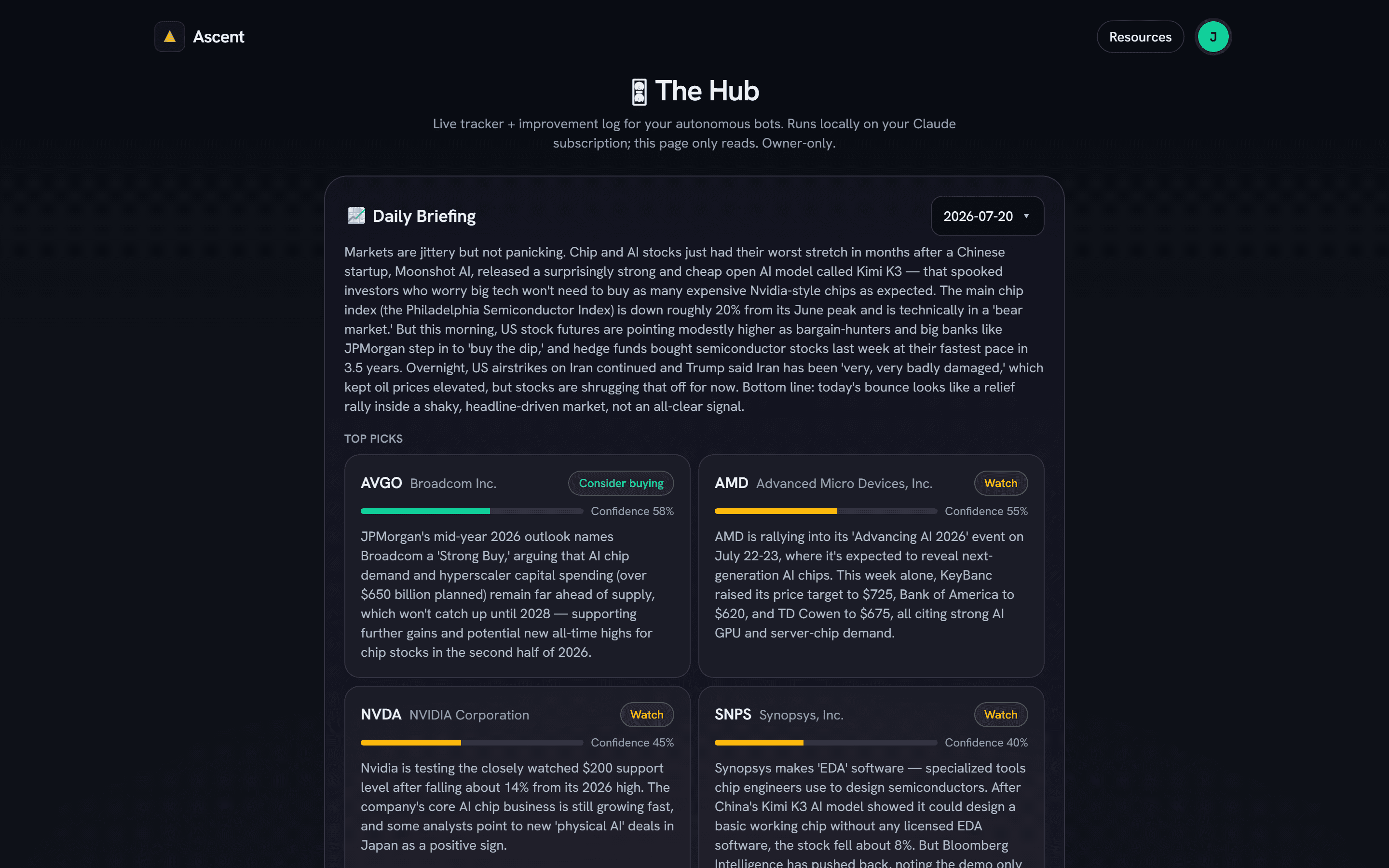
A bot that does the reading for you.
The goal
Ascent's thesis is difficulty control: learn any concept at the level you pick — "explain like I'm 5" through expert — with a tutor, Rise, that teaches at that altitude, quizzes you on what matters, and tracks honest mastery. The signature interaction is an altimeter: drag the gauge and the same idea is retaught at your level.
But difficulty is only half of it. The real barrier to learning from an expert isn't access — it's not knowing what to ask, because you don't yet know enough to ask a good question. Ascent solves that by tapping you on the shoulder: after every answer, Rise suggests the sharp next questions and maps the topics you'd branch into, so a total beginner can hold an expert-level conversation from the very first minute.
Around the tutor sits a full game layer that makes daily return worth it — XP, streaks, currencies, loot caches, boss encounters, live games with friends — and a professional Focus mode that strips all of it away for serious study. Finance leads the catalog, with licensing-exam prep (Series 65, CFP) as the high-stakes wedge, and sectors from health to technology behind it.
Background
Ascent is the biggest thing I've built: courses across eight sectors, two experiences in one design system (Play and Focus are a mode flag, never a fork), a shop and cosmetics economy, co-op and head-to-head games, practice exams, flashcards, and daily review — held together by a strict theming contract that guarantees no equipped background can ever break legibility.
It's engineered like a product, not a demo: a 54-test unit suite gating pushes, WCAG AA as a release gate, an access-control audit that caught locked-course content leaking into daily review, and written product and design docs that every change is checked against.
Built with AI
Ascent runs my process at its largest scale: strategy and design live in versioned docs (the product brief names the users, the brand, and the anti-references), specs and plans precede every feature, and Claude executes under review. Rise itself is Claude-powered — one tutor, one topic-finder, one consistent vocabulary enforced across the app.
The most interesting part is what grew around it: Ascent spawned its own toolchain of market-research bots and quant tools (below), each with the same rule the stock-analysis tool set — AI writes the narrative, but every forward-looking number comes from real data and transparent math. The model is forbidden from inventing prices.
The toolchain
Daily market briefing bot
Every weekday at 8am, a bot researches AI, semiconductor, and quantum news by web search and publishes a briefing into Ascent's Hub before the market opens — running on a subscription Claude worker at $0 API cost. On Sundays it scores its own past picks against real prices and writes a self-review.
Stock analysis tool
Type a ticker, get a full read: a CAPM-based growth projection, volatility ranges, analyst consensus, technicals, fundamentals, and macro backdrop. Every number is computed from market data; Claude only interprets the figures — it cannot fabricate a target or a return.
Stock screener + paper-trade recap
A standalone quant screener that ranks sector universes by a composite of analyst upside, momentum, and value — pure math, no LLM, no API cost. It runs a daily loop: screen, pick, place paper trades on Alpaca, and recap the P&L against its own logged track record. No real money is ever traded.