Project 7 of 10
Eagle U Mentor Match
A mentor-matching app for a youth success program's roundtable event — ranked matches and tailored questions for every student.
Ever sit across from someone impressive and blank on what to even ask? What if, before you met a single mentor, you already knew who to talk to — and exactly what to ask them?
See it work
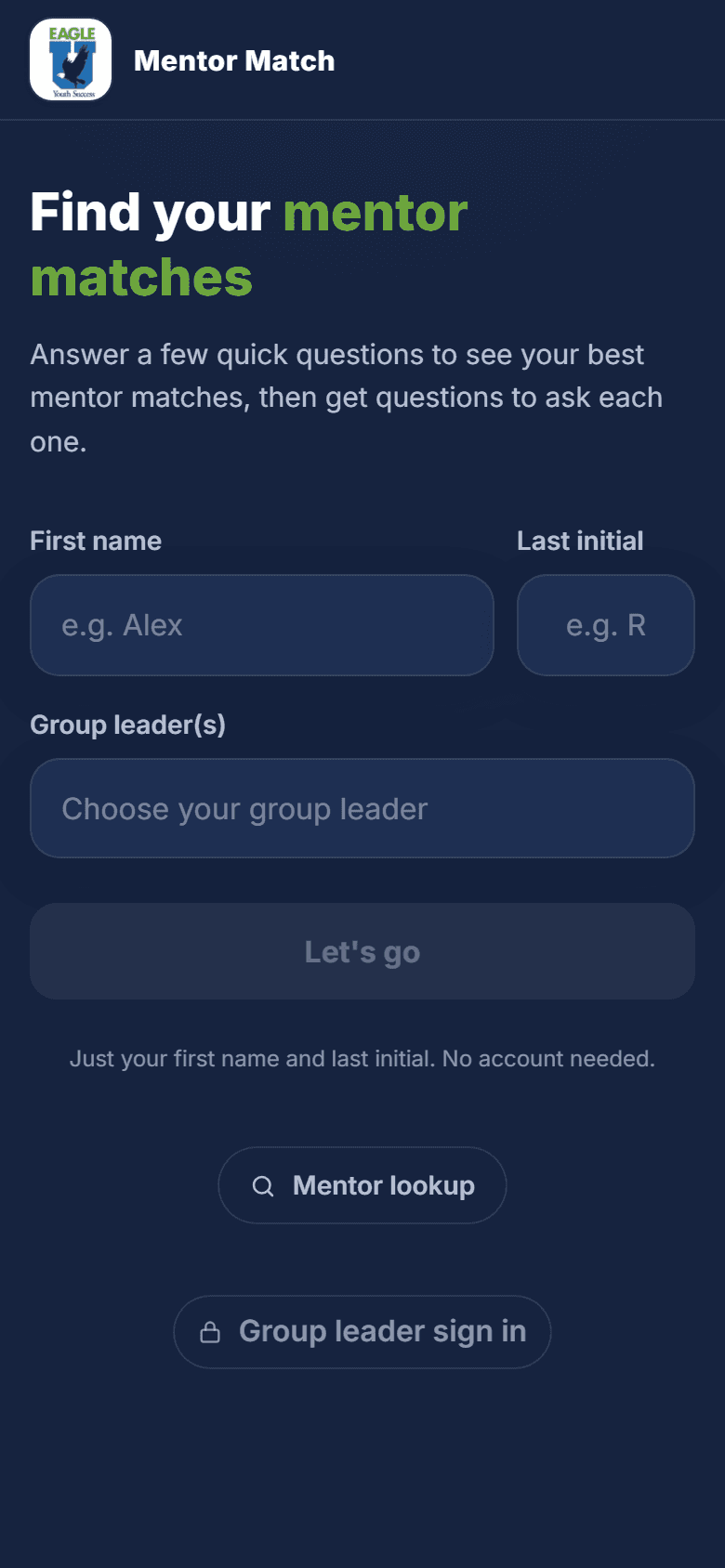
No sign-up, just go.
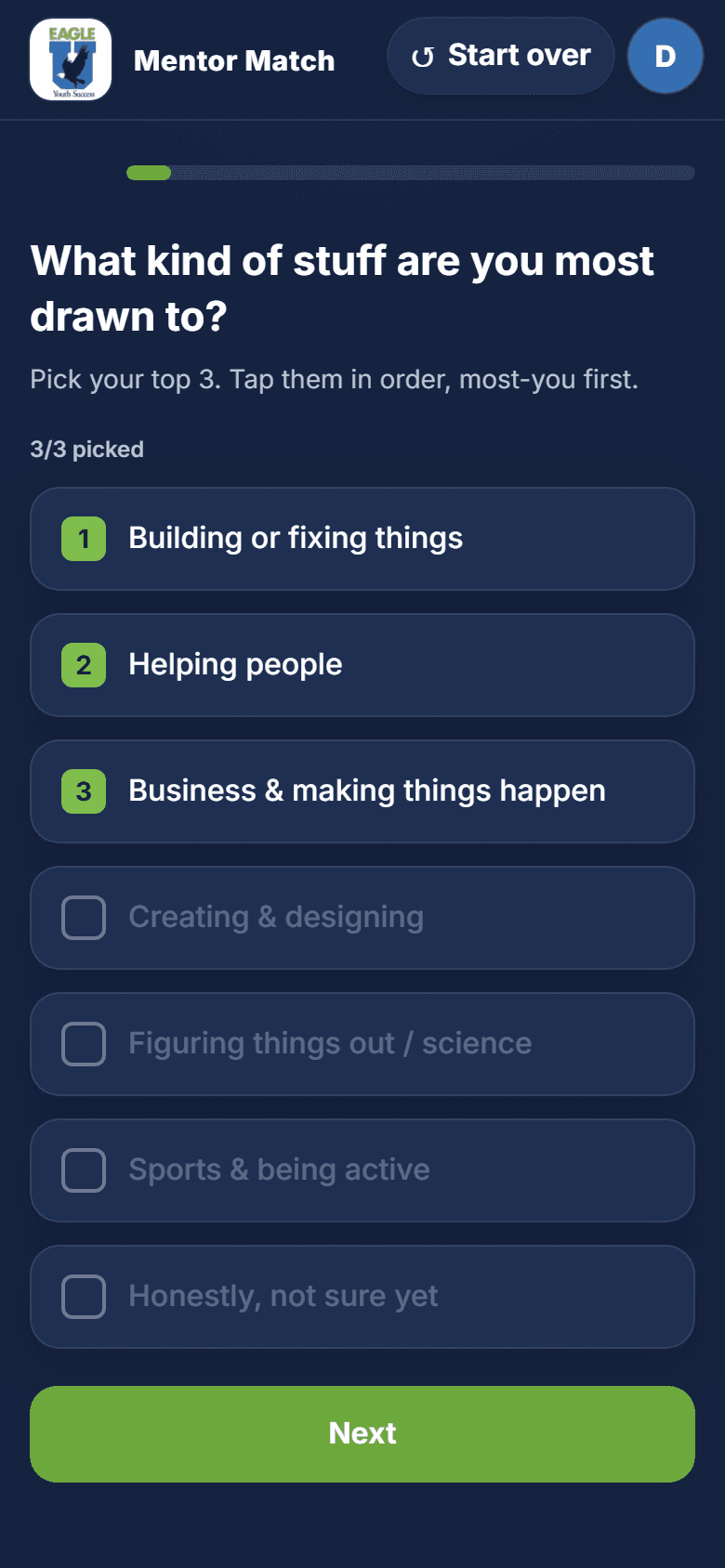
Answer a few quick questions.
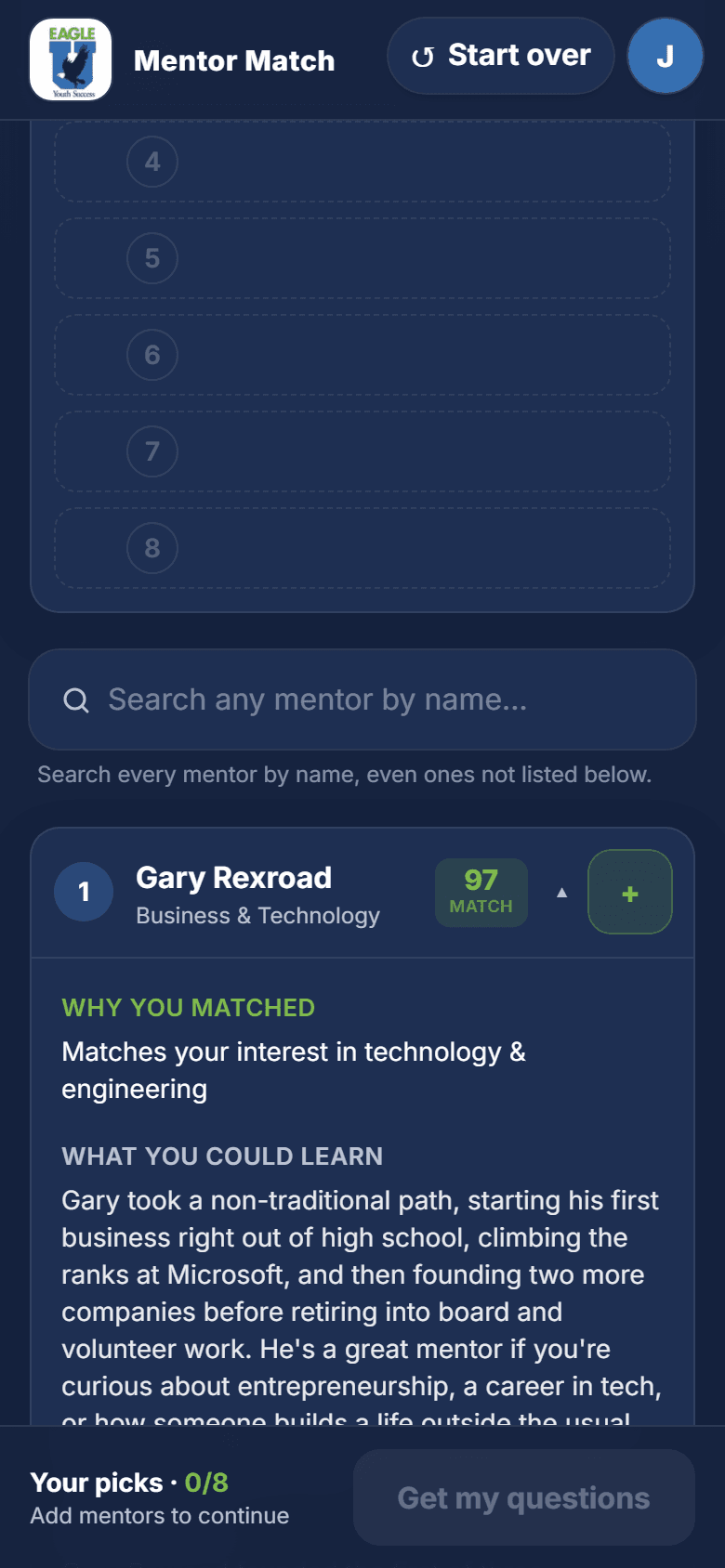
See your best matches, ranked.
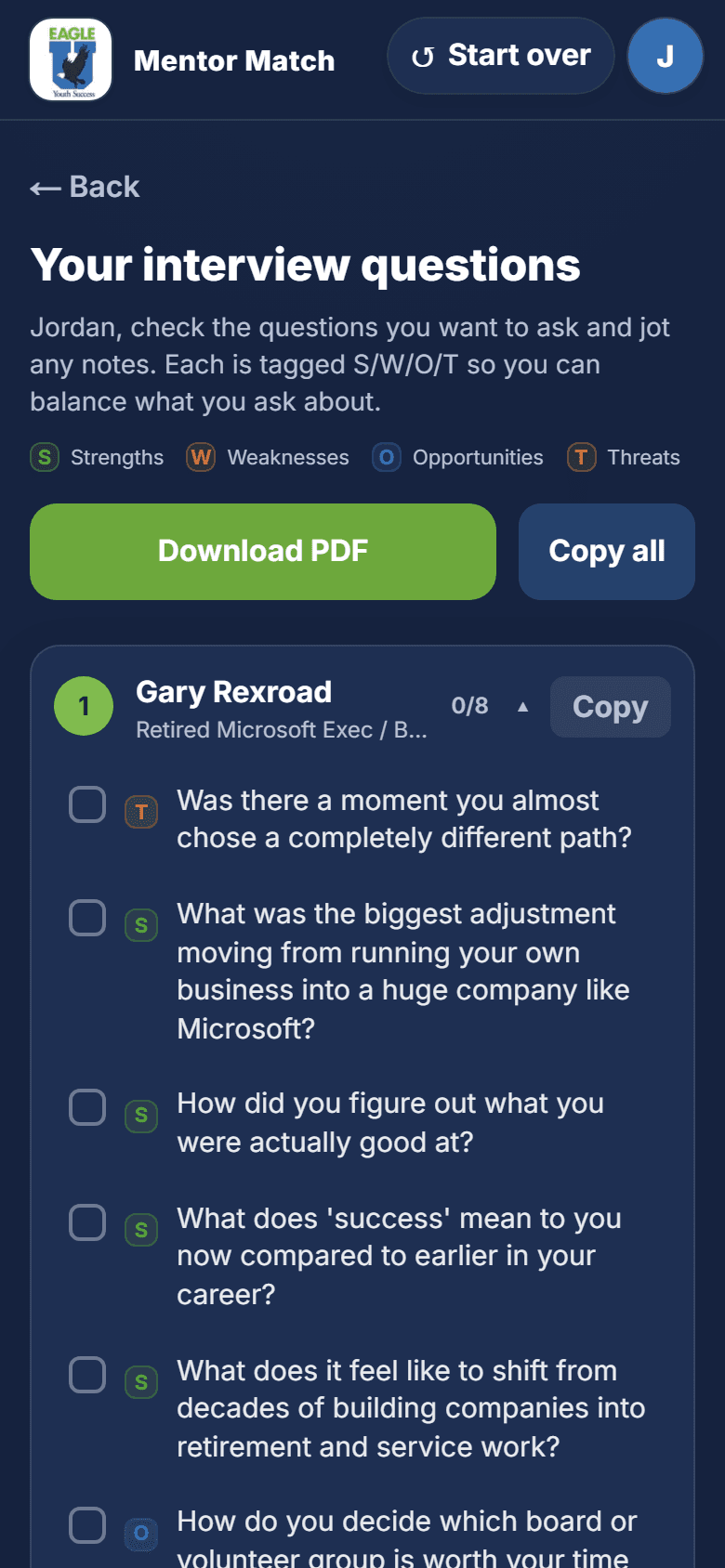
Walk in knowing what to ask.
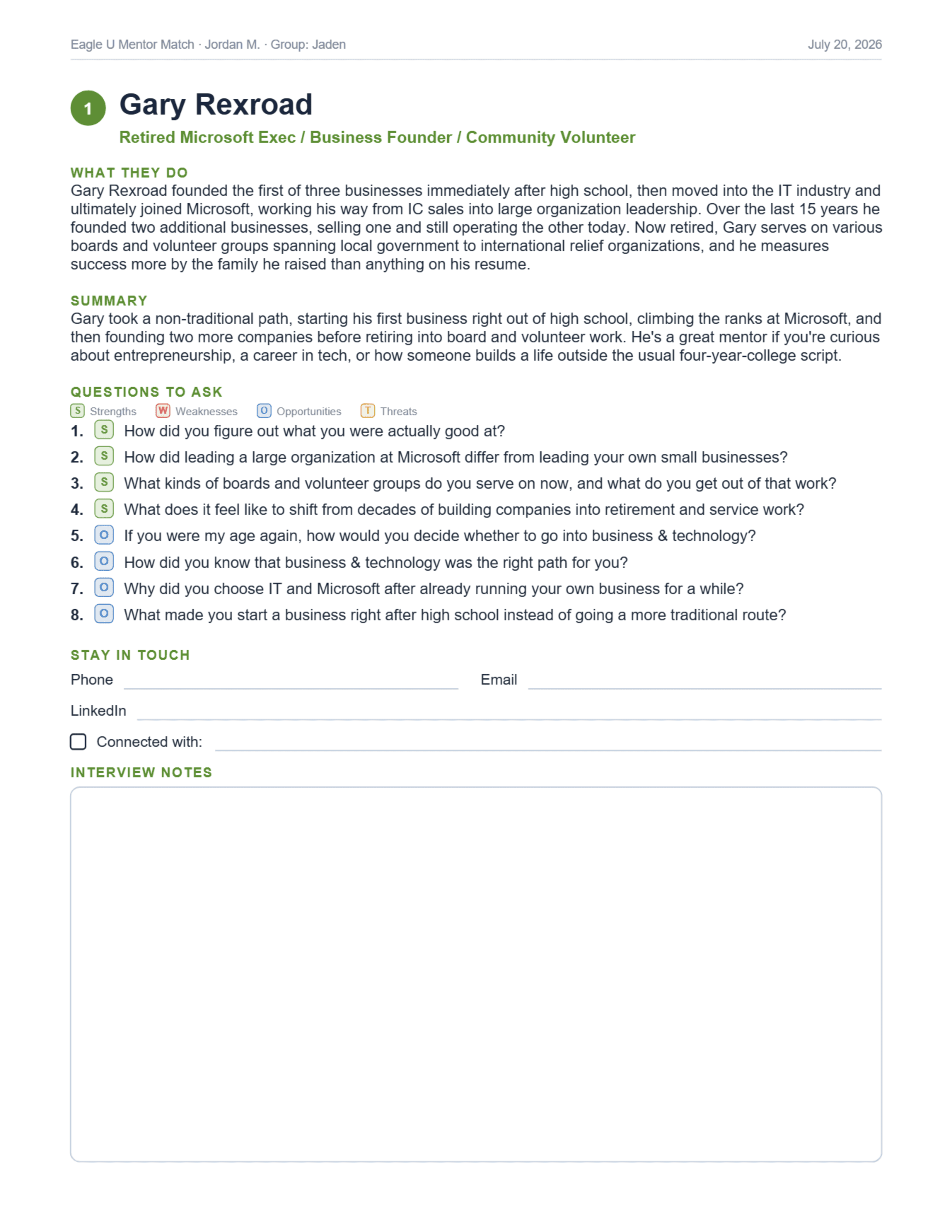
Take it to the table as one printable page.
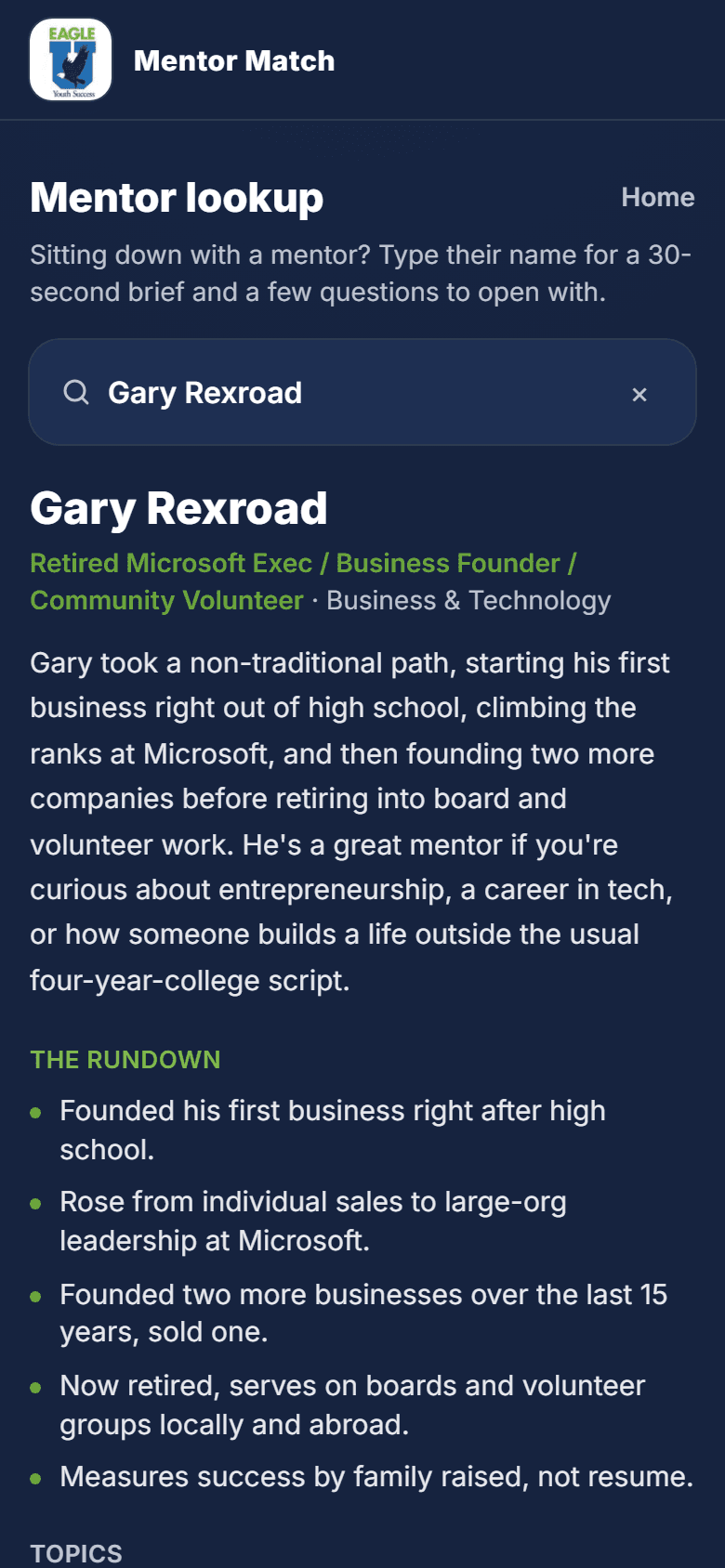
For team leaders: look anyone up on the spot.
The goal
Eagle U is a youth success program — a week that ends with students sitting down for roundtable conversations with dozens of accomplished mentors. The problem: students walk into those rooms knowing almost nothing about the person across the table, so the first minutes burn on "so, what do you do?" and the questions stay generic.
Mentor Match fixes that. A student answers a short adaptive questionnaire, gets a ranked list of mentors with a one-line reason for each match, picks their top six, and receives interview questions tailored to their goals and each mentor's field — so the conversation is productive for both the student and the mentor from the first minute.
Two kinds of people walk into that room, and the app serves both. Students get the full flow — the quiz turns hours of research into a two-minute questionnaire and hands back a printable one-pager to carry to the table and keep. Team leaders have the opposite problem: they can't sit until every student is seated, then drop into whatever seat is open, often across from a mentor they've never heard of. For them there's a lookup tool — read the nametag, type the name, and get an instant brief and a few opening questions before they've even pulled out the chair.
Background
It ran for real at the July 2026 session at Baker University, where I came back as a Team Leader after four summers as an attendee and used it to run my own team's roundtables. It started selfishly: I wanted to walk into my own roundtables already knowing each mentor's world. Then it grew two more jobs — collapsing the research burden for every student at the event, and giving a room full of students a first-hand introduction to what AI-built software can actually do.
It's engineered for event conditions: a hundred students hitting it at once on venue Wi-Fi. The deployed app makes zero runtime AI calls — the questionnaire is a deterministic branching tree that feels adaptive, ranking is a transparent weighted overlap scored 0–100, and progress lives in the browser so a mid-event refresh loses nothing. Coordinators watch live mentor demand on an admin dashboard; group leaders get a mentor-lookup view.
Built with AI
The constraint shaped the architecture: my Claude subscription was the only paid source allowed, so the intelligence is baked in at build time instead of called at runtime. Claude enriched dozens of raw mentor bios into structured, human-reviewed records and pre-generated bespoke questions per mentor — then the deployed app runs on pure, free, deterministic code that can't be rate-limited mid-event.
The app itself was the demo: for most students, this was the first time software built by directing AI did something concrete for them — it researched the mentors so they didn't have to.