Project 3 of 10
Life Platform
A personal life OS — daily brief, calendar, people, workouts, money, and three inboxes in one place that already knows you.
Ever bounce between six different apps just to figure out what your day actually looks like? What if one calm screen already knew — and told you what matters the moment you opened it?
See it work
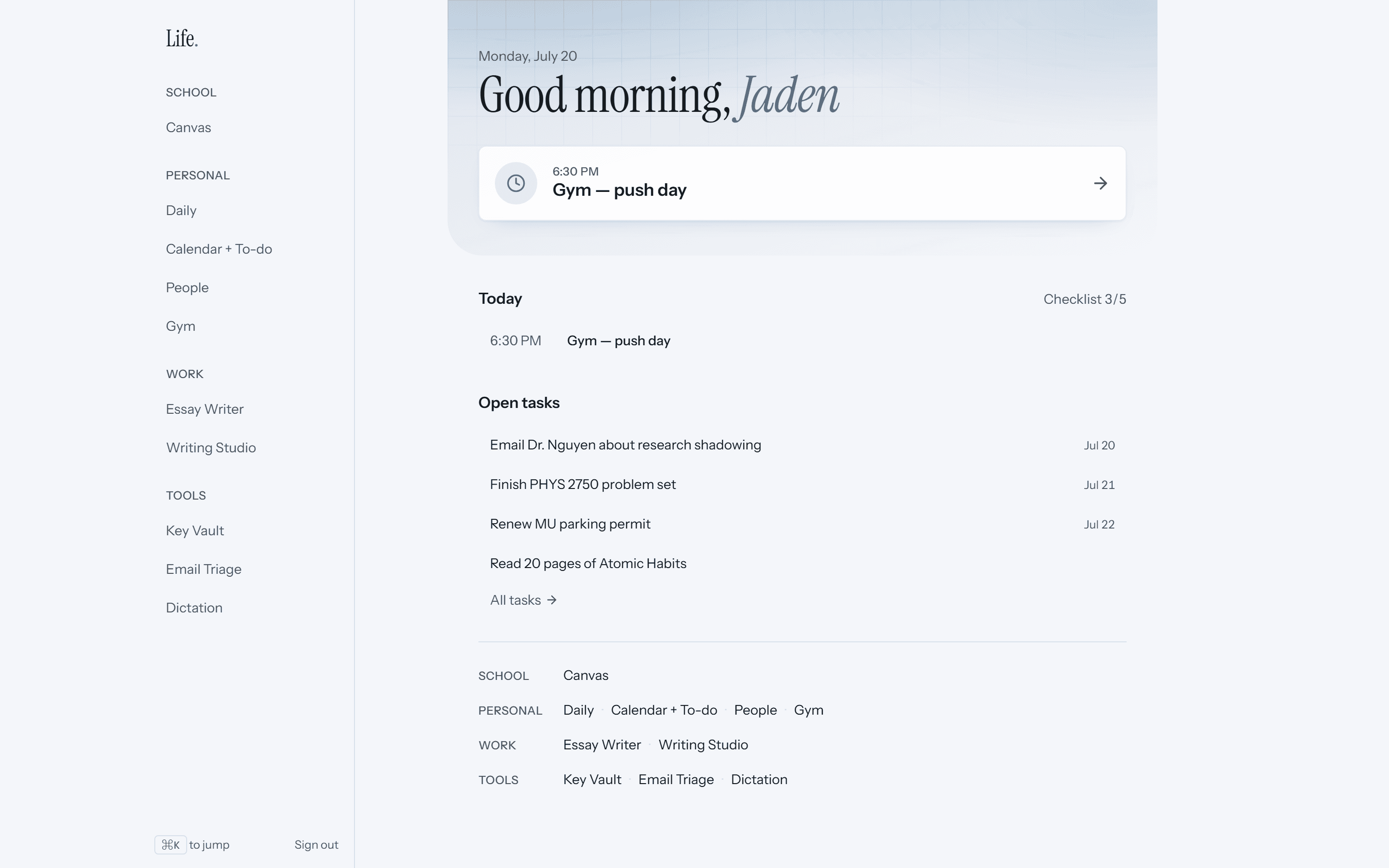
Your morning, already sorted.
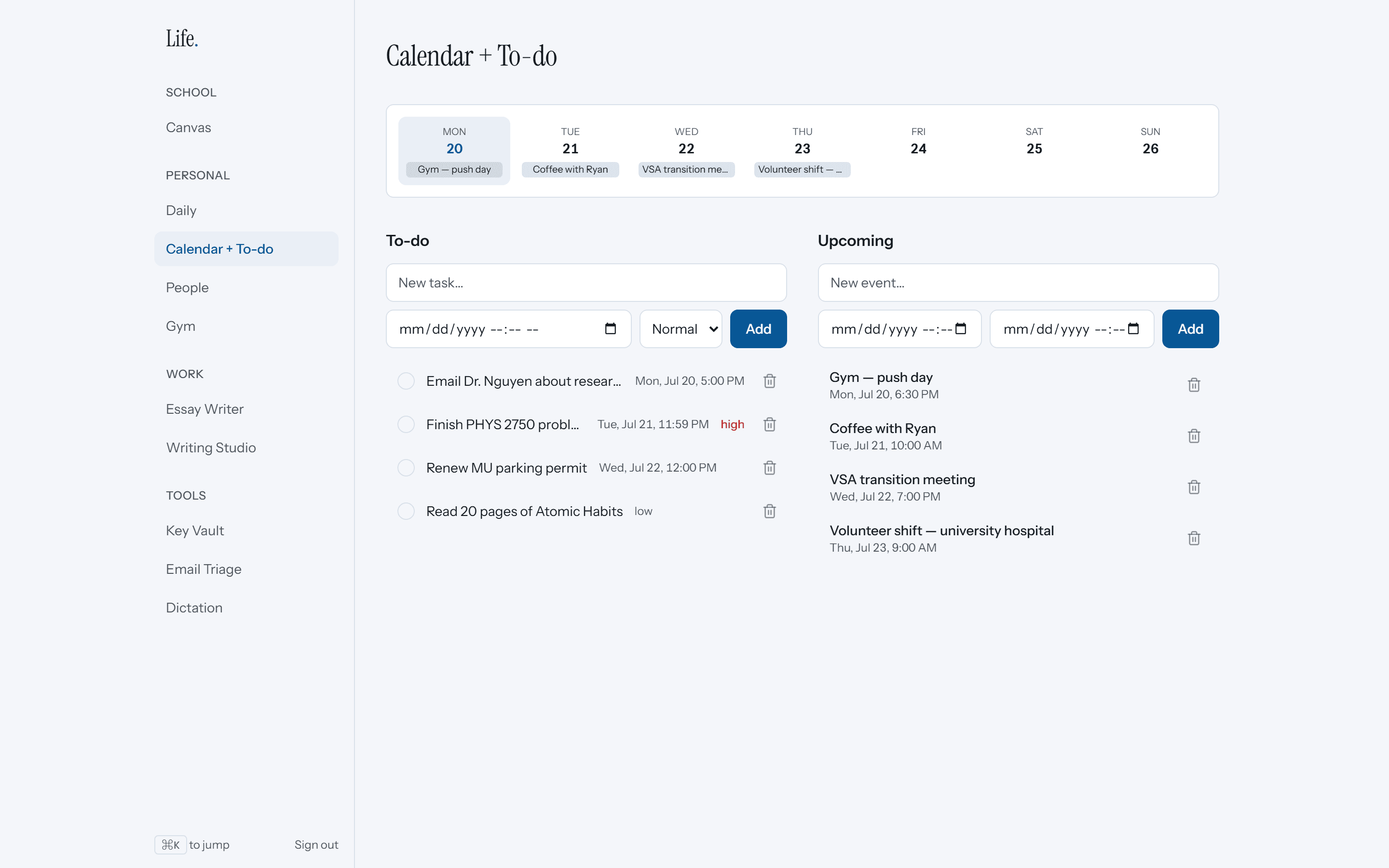
The whole week on one screen.
The goal
I wanted to run my entire day from my phone without bouncing between six apps. Life Platform is one calm surface that answers a single question the moment it opens: what matters right now? The Today view is a briefing, not a launcher — checklist, goals, and a daily brief assembled for me before I ask.
Around that core sit modules for the rest of my life: a calendar with tasks, a friends-and-family CRM so the people I care about never fall through the cracks, school integration, and email triage that compresses an inbox into one calm daily digest. One shared AI Brain sits across all of it, deciding what deserves my attention.
Background
This started as a personal app and turned into a platform on purpose. Every feature is a self-contained module behind a config flag, and the whole thing is architected as a template: a future user is a new row of config, never new code. The rule I held the build to — if you're about to write "if user is Jaden," stop and put it in config.
Since launch it has kept growing into the rest of my life: workout logging that learns my routine and pulls sleep and cardio from Fitbit, a health dashboard, read-only bank, card, and brokerage balances through Plaid and SnapTrade, contacts imported from iCloud with voice-captured notes that land in the CRM, and email triage that swipes through iCloud, Outlook, and Gmail with a rulebook per inbox. Every one of those is a module behind a config flag, same as day one.
It's built phone-first as an installable PWA, with the discipline of a real product: row-level security on every table, an encrypted key vault with a setup wizard, design tokens instead of ad-hoc styling, and every action acknowledging instantly. Every module is live, from shell and auth through email triage, and it is the app I open first every morning.
Built with AI
This is the project where my process matured: brainstorm the design first, lock a written spec, then direct Claude through implementation module by module, reviewing every diff before it lands. The spec defines what "done" means for a module — config-gated, RLS-safe, mobile-ready — and nothing merges until it clears that bar.
The product itself runs on AI too. The AI Brain is a single service the modules feed context into — no scattered prompts — powered by a Claude worker running on a subscription rather than metered API keys. Designing that architecture, and holding every module to it, was as much of the work as any interface.